
You know that your time is better spent on high-level strategy and marketing, yet the daily grind keeps pulling you back in. We understand the frustration of inconsistent service and the revolving door of unvetted freelancers. This guide provides a clear roadmap to reclaiming your schedule. You’ll discover how to find a reliable, full-time partner who understands your business inside and out. We’ll cover everything from identifying the right tasks to offload to integrating a professional from the Philippines into your core team. By the end, you’ll have the blueprint for a streamlined, self-running store that operates with precision and ease.
Key Takeaways
- Define the 2026 ecommerce virtual assistant as a platform-specialist who manages Shopify, Amazon, or Walmart stores with technical precision.
- Identify the strategic roles that bridge the gap between daily operations and long-term business growth to reclaim your executive time.
- Compare the stability of full-time managed staffing in the Philippines against the high turnover and risks found in the unvetted freelance gig economy.
- Learn the essential steps for building robust standard operating procedures that ensure your new hire integrates seamlessly into your existing team.
- Discover how a managed partner removes the friction of recruitment, payroll, and HR so you can focus exclusively on high-level store strategy.
What is an Ecommerce Virtual Assistant? (The 2026 Definition)
An ecommerce virtual assistant is a specialized remote professional dedicated to the operational success of online retail brands. While many people ask What is a Virtual Assistant? to understand the general profession, the ecommerce variant requires a much narrower focus. They aren’t just answering emails or scheduling meetings. They are managing product lifecycles, optimizing listings, and ensuring the technical health of your digital storefront. In 2026, this role has become the operational engine of every scalable online store.
The landscape has changed. It’s no longer enough to hire someone who can simply “do tasks.” Today’s professionals must manage complex AI-driven tools and automated customer journeys. They act as the strategic supervisor for the automated systems that keep your store running 24/7. This shift requires a professional who understands how to leverage technology rather than just being a passenger to it. They ensure your automated emails actually fire and your AI chatbots provide accurate product information at all times.
The Evolution of Remote Ecommerce Support
The industry has moved far beyond simple data entry. Today, your store needs an operations manager who understands the “why” behind the data. Integrating a digital marketing virtual assistant allows you to bridge the gap between keeping the lights on and actually growing your revenue. The Philippines has emerged as the premier destination for this specialized talent. The region offers high English proficiency and a deep cultural alignment with Western retail standards. It’s a hub of specialized professionals who treat your store like their own business.
Key Platforms Your VA Should Master
A qualified ecommerce virtual assistant should arrive with a baseline mastery of the specific tools you use. This isn’t the time for on-the-job training for basic platform navigation. Precision matters. Efficiency is everything. You need a partner who can navigate the complex ecommerce stack with confidence.
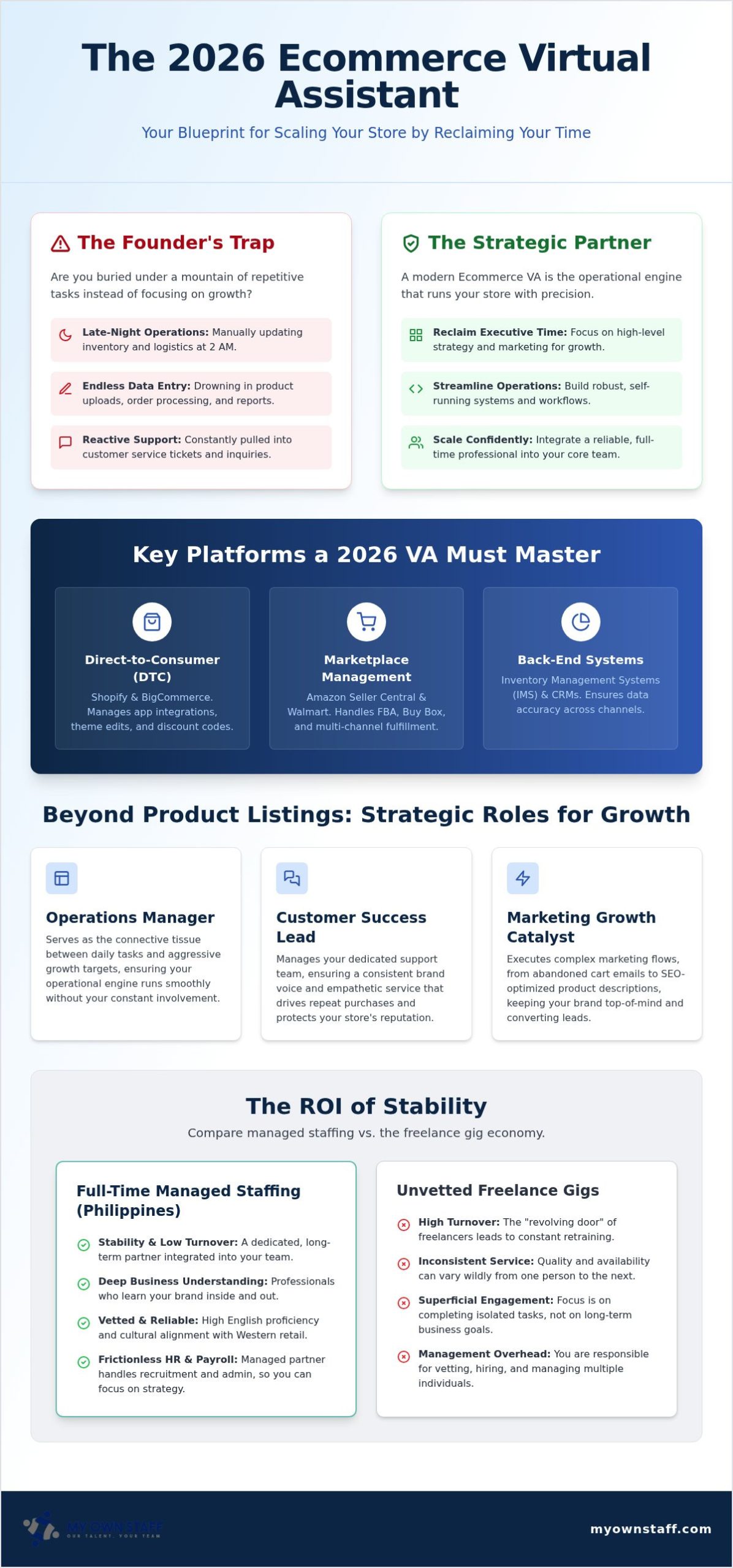
- Direct-to-Consumer (DTC): Proficiency in Shopify or BigCommerce. They should handle app integrations, theme customizations, and discount code management without constant hand-holding.
- Marketplace Management: Deep knowledge of Amazon Seller Central and Walmart Marketplace. This includes managing Buy Box competition, handling FBA shipments, and multi-channel fulfillment.
- Back-end Systems: Experience with Inventory Management Systems (IMS) and CRM tools. They must keep customer data clean and stock levels accurate across every sales channel.
Success in 2026 depends on this technical depth. When your team understands the platforms as well as you do, your business gains the agility needed to outpace the competition.
Beyond Product Listings: Strategic Roles for Your Store
Many founders start by looking for someone to handle simple product uploads. While that is helpful, a modern ecommerce virtual assistant provides far more strategic value. They serve as the connective tissue between your daily operations and your aggressive growth targets. By identifying easily outsourced tasks, you can shift your focus from working in the business to working on the business. This isn’t just about clearing your inbox. It’s about building a sustainable infrastructure that survives beyond your personal involvement.
One of the most impactful shifts you can make is moving from reactive support to a dedicated customer success team managed by offshore staff. In 2026, customer loyalty is won through speed and empathy. A full-time assistant ensures that every inquiry is met with a consistent brand voice. This protects your store’s reputation and drives the repeat purchases necessary for long-term scaling. Consistency is the foundation of trust.
The Digital Marketing Virtual Assistant Component
A high-performing assistant acts as a growth catalyst. They don’t just post on social media; they manage your presence to keep your brand top-of-mind for your audience. They execute complex email marketing flows that nurture leads into buyers. From setting up abandoned cart sequences to optimizing product descriptions for SEO, they ensure your marketing engine runs without your constant supervision. This technical execution allows you to test new strategies and creative angles faster than ever before.
Operations and Inventory Management
Operational mastery is where an ecommerce virtual assistant truly shines. They handle the logistical heavy lifting that often leads to founder burnout. They manage the details so you don’t have to.
- Supplier Coordination: They track stock levels and ensure reorders happen before you hit zero.
- Returns Management: They process exchanges efficiently to maintain high marketplace ratings and customer trust.
- Channel Syncing: They update pricing and promotions across Shopify, Amazon, and Walmart simultaneously to ensure parity.
Maintaining this level of brand consistency across every touchpoint is what separates hobbyist stores from professional brands. If you’re ready to build this foundation, consider how dedicated remote professionals can stabilize your operations today.
The ROI of Managed Offshore Staffing vs. Freelance Gigs
Scaling an online store requires a fundamental shift from hiring “help” to building a team. Many founders fall into the trap of the gig economy. They hire unvetted freelancers for one-off tasks, only to find themselves stuck in a cycle of constant retraining and high turnover. When a freelancer leaves, they take your store’s institutional knowledge with them. A dedicated ecommerce virtual assistant solves this by becoming a permanent fixture in your business operations. They learn your brand, your customers, and your unique workflows. This continuity is what allows a business to move from chaos to order.
Choosing the right model is critical for long-term stability. By hiring a virtual assistant in the Philippines through a managed service, you eliminate the risks associated with independent contractors. You gain the cost-efficiency of offshore rates without the administrative headache of HR, payroll, and recruitment. A managed partner acts as your operational safeguard. They ensure that the talent you bring on board is pre-screened, technically capable, and committed to a full-time role. You aren’t just buying hours. You are investing in a dedicated partner who is incentivized to see your store succeed.
Stability and Security in Remote Hiring
Data security is a non-negotiable priority for modern ecommerce. Giving an unvetted freelancer access to your Shopify backend or customer database is a significant liability. Managed staffing models provide a layer of accountability that the freelance market cannot match. Professional agencies conduct rigorous background checks and ensure that staff members follow strict security protocols. This level of oversight protects your store’s sensitive information and gives you the peace of mind needed to delegate complex tasks with confidence. Reliability is the ultimate currency in remote work.
Calculating the Real Cost of Your Time
Founders often suffer from the “Founder’s Trap.” This occurs when you continue to handle manual data entry or basic customer tickets because it feels “cheaper” than hiring. In reality, every hour you spend on a low-level task is an hour stolen from high-level growth strategy. If your strategic time is worth hundreds per hour, doing the work of a $15 per hour assistant is a massive net loss for your business. A dedicated VA pays for themselves by expanding your operational capacity and freeing you to focus on the levers that actually drive revenue.
For a 7-figure store owner, delegating daily operations to a professional partner is the only way to reclaim the mental bandwidth required to scale toward 8-figures and beyond.
5 Steps to Integrating a VA into Your Ecommerce Workflow
Integration is the bridge between hiring talent and seeing real business results. Most founders fail here because they treat a new hire like a temporary fix rather than a long-term asset. To see a return on your investment, you must prepare your business environment before the first day. A successful ecommerce virtual assistant needs a clear roadmap to follow. Without it, you’ll find yourself answering the same questions every week. This section outlines the disciplined approach required to build a self-running store through a five-step process: task auditing, documentation, tool selection, KPI setting, and feedback loops.
Creating Your Documentation Foundation
Documentation is the backbone of a scalable business. You can’t delegate what you haven’t defined. Start by recording Loom videos for every repetitive task in your store. Whether it’s processing a specific type of return or updating a product variant, a video is worth a thousand pages of text. Organize these into a shared knowledge base using tools like Notion, Google Drive, or a dedicated Slack channel. Clear documentation removes the friction of “how-to” questions and allows your assistant to work independently. Finally, set specific KPIs for the first 90 days. Measure success through accuracy and speed rather than just hours worked. This ensures your new hire understands exactly what “done” looks like in your organization.
The Onboarding and Training Phase
Onboarding is a marathon, not a sprint. Establish a daily “stand-up” rhythm early on. A quick 15-minute sync ensures everyone is aligned on the day’s priorities and prevents small issues from becoming bottlenecks. Start with gradual delegation. Let your assistant handle simple customer inquiries before moving to complex inventory management or supplier coordination. In 2026, you should also train your assistant to use AI tools for drafting product content or summarizing customer tickets. This hybrid approach, human oversight paired with AI efficiency, is how modern stores scale at pace. It’s about empowering your team with the best possible tech stack to maximize their output.
Preparing your internal systems is the most important step in this journey. For a more detailed breakdown of what to prepare, review our virtual assistant for business owner scaling checklist. If you’re ready to skip the recruitment headache and hire pre-vetted talent, you can start building your dedicated team here. Taking the time to build these systems now will save you hundreds of hours in the future.
Streamlining Your Growth with My Own Staff
Scaling a store requires more than just a hire. It requires a system. My Own Staff acts as your strategic partner for offshore staffing solutions, removing the administrative friction that often stalls growth. We don’t just find you an ecommerce virtual assistant; we build the operational infrastructure around them. By handling recruitment, HR, and payroll, we allow you to focus on the high-level strategy that actually moves the needle. Our managed model is designed for founders who value their time and demand operational mastery.
The difference lies in dedication. Unlike the shared resource models or project-based freelancers discussed earlier, our professionals work exclusively for you. They are integrated into your culture, your workflows, and your long-term goals. This exclusivity ensures that your business receives the undivided attention it deserves. You aren’t competing for your assistant’s time with other clients. You have a reliable, full-time partner who is as committed to your store’s success as you are. It’s a partnership built on stability and results.
Why a Philippines-Based Dedicated Team?
The Philippines is the premier destination for high-level ecommerce talent for several reasons. First, the cultural alignment with Western retail standards is unmatched. Second, the English proficiency is exceptional, ensuring seamless communication with your customers and team. Our staff members arrive with deep expertise in the tools you already use, from Shopify to Amazon Seller Central. Because we provide a managed remote environment, you gain a level of reliability and professional oversight that independent contractors simply cannot provide. We create a stable, high-performance work culture that lasts.
The My Own Staff Hiring Process
We don’t believe in a one-size-fits-all approach. Our process begins with understanding your specific tech stack and operational gaps. We source candidates who already possess the technical skills required to manage your unique business. Each professional undergoes rigorous pre-screening and technical testing to verify their capabilities before they ever interview with you. Once hired, we provide ongoing support to ensure long-term retention and peak performance. We handle the management details so you can lead your company with confidence. Our goal is a seamless integration that feels natural from day one.
Ready to reclaim your time and scale with ease? Book a consultation today to find your ideal ecommerce virtual assistant and start building a store that runs itself with precision and order.
Scaling with Operational Mastery
Scaling your store in 2026 isn’t about working harder; it’s about building a smarter operational engine. You’ve seen how a specialized ecommerce virtual assistant can transform your business from a manual grind into a streamlined growth machine. By moving beyond simple product listings and embracing strategic delegation, you reclaim the mental bandwidth needed to lead. The choice between unvetted freelancers and a dedicated, managed partner is often the difference between constant turnover and long-term stability.
Success starts with preparation. When you combine robust SOPs with full-time, dedicated talent from the Philippines, you create an environment where scaling becomes inevitable. My Own Staff handles the heavy lifting of recruitment, HR, and payroll so you can stay focused on high-level strategy. Our pre-vetted professionals are ready to integrate into your team and treat your store with the same care you do.
It’s time to stop managing tasks and start leading your brand. Build Your Dedicated Ecommerce Team Today and experience the peace of mind that comes with operational mastery. Your store’s next level of growth is waiting.
Frequently Asked Questions
What is the difference between an ecommerce VA and a general VA?
An ecommerce virtual assistant is a platform specialist who focuses exclusively on the technical and operational needs of online retail. While a general assistant handles administrative tasks like scheduling or basic data entry, an ecommerce specialist manages inventory, optimizes product listings, and navigates marketplace algorithms. They arrive with a deep understanding of the specific software that drives your sales, making them a strategic asset rather than just an administrative helper.
How much does it cost to hire an ecommerce virtual assistant in 2026?
Costs vary based on experience and the specific technical skills required for your store. While offshore rates remain highly cost-effective compared to local hiring, you should expect to pay for specialists who master complex platforms like Amazon or Shopify. Managed staffing models include recruitment and HR support in their fee structure, providing a more stable and predictable long-term investment than the volatile freelance market.
How do I handle store access and security with a remote assistant?
Security is managed through restricted user permissions and encrypted password management tools. Most ecommerce platforms allow you to create staff accounts with limited access, ensuring your sensitive financial data remains protected. Working with a managed service provider adds an extra layer of security, as candidates undergo background checks and operate within a professional, supervised environment. This structured approach minimizes risk while maximizing operational efficiency.
Can an ecommerce VA help with Amazon and Shopify simultaneously?
Multi-channel management is a core skill for an experienced ecommerce virtual assistant. These professionals are trained to sync inventory, update pricing, and manage customer service across several platforms at once. This technical depth ensures that your brand remains consistent whether a customer finds you on your direct storefront or a major marketplace. It allows you to expand your reach without doubling your personal workload.
Do I need to provide the equipment for my offshore staff?
You don’t need to provide hardware or software for staff hired through a managed agency. The service provider ensures that every professional has access to a high-speed internet connection and a modern computer setup. This removes the logistical burden from your shoulders and allows the assistant to start contributing to your store’s growth on day one. It’s a plug-and-play solution designed for rapid scaling.
What is the typical time zone overlap for a VA in the Philippines?
Professionals in the Philippines are highly adaptable and typically work on a schedule that aligns directly with your business hours. Whether you require a full night-shift overlap for real-time collaboration or a partial overlap for daily handovers, the team can accommodate your specific needs. This flexibility ensures that your store operations never miss a beat and communications remain fluid throughout the workweek.
How do I know if my store is ready for a full-time virtual assistant?
Your store is ready when you spend more than half of your day on repetitive tasks that don’t directly drive new revenue. If you have established consistent sales and have clear, repeatable processes, a full-time hire will provide the highest ROI. This transition allows you to move from being the primary operator to acting as the strategic leader of your brand, focusing on high-level growth.


