
Scaling your business on a rotating door of independent contractors is often a recipe for burnout rather than growth. You’ve likely felt the sting of a reliable freelancer suddenly “ghosting” a critical project or realized you’re spending more time managing small tasks than leading your company. When evaluating offshore staffing vs freelancing, the choice isn’t just about hourly rates. It is about the infrastructure of your future team.
We understand the frustration of acting as your own recruitment agency while trying to maintain quality. It’s exhausting to juggle inconsistent output while your management overhead climbs. This guide clarifies the structural differences, hidden costs, and operational impacts of both models so you can choose the right path for your business. We will explore the 2026 regulatory landscape, including updated worker classification standards, to ensure your strategy is secure. You’ll gain a clear framework to reduce your management burden and secure the stable, high-quality output your growth demands.
Key Takeaways
- Identify the “Upwork Trap” and recognize the specific operational signals that your business has outgrown project-based contractors.
- Compare the structural impacts of offshore staffing vs freelancing to determine which model offers the long-term stability and culture fit your growth requires.
- Audit your management capacity using our checklist to see if you have the bandwidth to lead individual freelancers or if you require a managed team approach.
- Uncover the hidden operational costs of DIY recruitment and learn how managed partnerships handle international compliance, benefits, and payroll for you.
- Follow a clear, two-step roadmap to transition from fragmented tasks to a dedicated team member who understands your business from the inside out.
Beyond the Gig Economy: Why Scaling Businesses Outgrow Freelancing
Hiring your first freelancer feels like a breakthrough. It is fast, affordable, and solves an immediate pain point. However, as your company expands, that convenience often transforms into a logistical anchor. Many founders fall into the “Upwork Trap,” where they rely on a revolving door of independent contractors to power core operations. While this works for one-off projects, it fails to provide the structural integrity needed for a growing department. By 2026, the global workforce has become increasingly fragmented, with freelancers representing nearly 47% of all workers. This saturation makes understanding outsourcing and offshoring a critical skill for leaders who want to move beyond simple task delegation.
The transition point occurs when the effort to manage the help exceeds the value of the work produced. You start spending more time in project management tools than in high-level strategy. This is the moment to shift your mindset. You are no longer just “hiring a pair of hands” to fix a temporary leak. You are building a department. When comparing offshore staffing vs freelancing, the primary difference is ownership. A dedicated staff member integrates into your culture, while a freelancer simply completes a ticket and moves to their next client.
The Management Tax of the Freelance Model
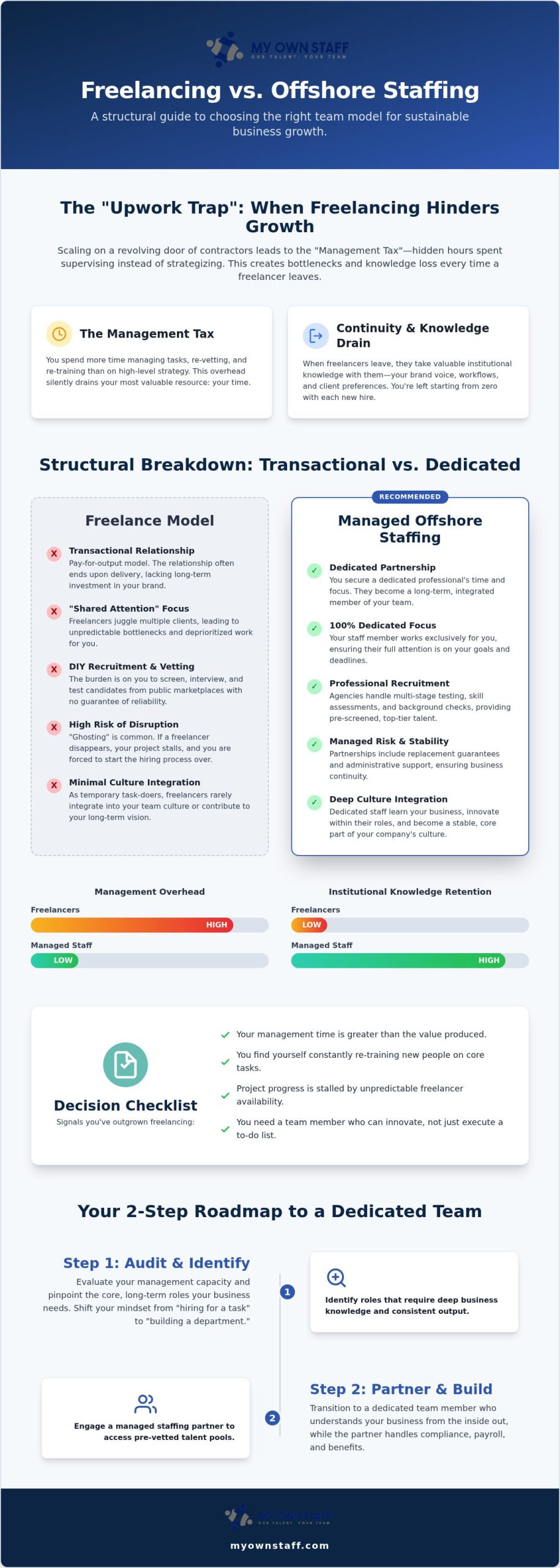
The Management Tax is the hidden hours spent supervising instead of strategizing. Every time a freelancer moves on to a higher-paying gig or “ghosts” a project, you pay this tax in the form of re-vetting and re-training. You aren’t just losing a worker; you’re losing the time it takes to bring a new person up to speed. Furthermore, freelancers operate on a “shared attention” model. Their deadlines are often dictated by whichever client is screaming the loudest that day. This lack of dedicated focus creates unpredictable bottlenecks that can stall your entire team’s momentum.
Continuity as a Competitive Advantage
Institutional knowledge is a quiet but powerful asset. When a freelancer leaves, they take their understanding of your brand voice, your client preferences, and your internal workflows with them. You’re left starting from zero. Dedicated offshore staffing solves this by prioritizing long-term stability. A full-time professional in a hub like the Philippines doesn’t just execute tasks; they innovate within their roles. They learn your business deeply enough to suggest improvements, identify risks, and act as a stabilizing force. In the high-stakes environment of 2026, having a team that knows your “why” is a massive competitive advantage over those still juggling fragmented gig-workers.
Structural Breakdown: Transactional Tasks vs. Dedicated Partnerships
Choosing between offshore staffing vs freelancing requires a look at the “why” behind the hire. Freelancing is essentially transactional. You pay for a specific output, like a single logo or a one-off technical fix. Once the file is delivered, the relationship often ends. Offshore staffing operates on a role-oriented mindset. You aren’t just buying a task; you’re securing a person’s time, focus, and professional growth within your organization. Understanding the essentials of outsourcing helps leaders see that a dedicated partner provides more than just labor. They provide continuity and a shared interest in your long-term success.
Ownership of the Recruitment Pipeline
Risk management is another critical differentiator. If a freelancer goes offline, your project stops. You are left to find a replacement, often losing days of progress and momentum. In a managed model, the agency shares the responsibility. They provide replacement guarantees and ongoing administrative support. This structure builds loyalty. Because the staff member is dedicated to your company alone, they become part of your culture. They understand your goals. They aren’t looking for their next gig while working on yours, which leads to higher-quality output and deeper integration.
Scalability and Flexibility
Both models have their place in a modern business. Freelancing is the clear winner for one-off, five-hour projects that require a highly specific, niche skill you won’t need again. However, for recurring, core functions, offshore staffing is the superior choice. If you are building Customer Success Teams or need consistent data entry, a 40-hour-per-week dedicated professional offers the reliability that a gig-worker cannot match. Many high-growth companies now use a hybrid approach. They use dedicated staff for daily operations and freelancers for occasional creative bursts. This strategy optimizes costs while maintaining a stable operational foundation. If you are ready to stop being a recruiter and start being a leader, consider how a dedicated remote professional could stabilize your workflow.
The Decision Checklist: Evaluating Your Business for Offshore Success
Determining the right model isn’t just about comparing price points. It’s about auditing your internal capacity. When weighing offshore staffing vs freelancing, the first step is an honest assessment of your current operational friction. Many business owners find that while individual contractors solve immediate problems, they don’t build long term value. To truly benefit from nearshore and offshore staff, you must first ensure your internal systems are ready for integration. Scaling takes discipline. It requires structure. While freelancers offer a quick fix for a sudden spike in workload, they rarely possess the institutional memory needed to manage complex, recurring cycles.
Managing five individual freelancers requires five times the communication, five sets of logins, and five different schedules to track. A managed team, however, consolidates this burden. You transition from a “recruiter” to a “leader” when you stop chasing updates and start reviewing results. Additionally, a low hourly rate often masks high overhead costs. You must account for the time spent on re-vetting and the potential risk of data breaches. Dedicated staffing models provide flat monthly fees and strict security protocols, ensuring your intellectual property remains protected within a controlled environment.
Operational Readiness Checklist
- Check 1: Do you spend more than 5 hours a week managing freelancers? If so, your management overhead is eating your profit margins.
- Check 2: Is the role essential to your daily operations? For recurring tasks handled by Data Entry Specialists, a dedicated professional provides the consistency that a gig worker cannot.
- Check 3: Can the tasks be standardized into a repeatable process? Roles that follow a clear SOP are perfect candidates for a full time offshore hire.
Onboarding Comparison Checklist
Onboarding a freelancer is usually limited to a task brief. There is no cultural integration and a high risk of a quick exit if they find a better project. In contrast, dedicated staff onboarding involves full system access, KPI setting, and long term career pathing. This creates a sense of belonging and professional investment. A remote employee onboarding checklist for dedicated staff is an investment in retention, not just a setup step. By choosing a dedicated model, you’re building a foundation that supports future expansion rather than just patching a current hole.
Frictionless Growth: The Managed Staffing Advantage
Scaling a team requires more than just talent. It requires a robust administrative backbone. When comparing offshore staffing vs freelancing, the most significant difference lies in who handles the “invisible” work. For a freelancer, you act as the primary administrator. You manage the contracts, handle international bank transfers, and navigate the complex legalities of foreign labor laws. In a managed model, these burdens disappear. We handle the payroll, local benefits, and compliance requirements in the Philippines, allowing you to focus on high-level growth instead of paperwork.
Operational security is another critical factor. A freelancer typically uses a personal laptop with varying security standards. Managed staffing provides a controlled environment. We ensure your team has the necessary infrastructure and high-speed internet to remain productive. If a staff member isn’t the right fit, you don’t have to start the recruitment process from scratch. Replacement guarantees ensure that we find a new professional to fill the gap, protecting your momentum and reducing the stress of turnover. Having a local Success Manager on the ground prevents remote team friction before it starts, acting as your eyes and ears in the local talent hub.
Removing the Administrative Burden
Managed staffing eliminates the friction of daily operations. We take over attendance tracking, software licensing, and local holiday management. This is especially vital for roles like IT Support Technicians, where managed workstations and secure remote environments are non-negotiable. By offloading these details, you reduce the mental load on your leadership team. You gain the peace of mind that comes from knowing your remote infrastructure is being professionally monitored and maintained, ensuring your business remains compliant with evolving international standards.
Long-term Cost Optimization
Predictability is the foundation of a healthy 2026 budget. Freelancer rates can fluctuate, and platform fees on sites like Fiverr (20%) or Upwork (up to 15%) add up quickly. A flat monthly fee for dedicated staff provides a clear financial roadmap. This model also protects you from the “Failed Hire Tax.” A bad hire can cost a business over $4,000 in lost time and productivity. Managed services mitigate this risk through rigorous screening and ongoing support. The true ROI comes from retention. Keeping one dedicated professional for three years is significantly more cost-effective than the expensive cycle of re-hiring and re-training ten different freelancers.
Don’t let administrative friction stall your expansion. If you are ready to build a stable, professional team, explore our managed staffing solutions to see how we can streamline your operations.
Transitioning to a Dedicated Model with My Own Staff
Moving from a fragmented gig model to a structured team is a significant milestone for any scaling business. The choice between offshore staffing vs freelancing often comes down to how much control you want over your operational future. While freelancers provide a temporary bridge, a dedicated partnership builds a permanent foundation. We have refined a four-step process to help you exit the cycle of constant re-hiring and move toward a model of operational mastery.
Step 1: Identify the high-friction roles. Most businesses begin by identifying the position that carries the highest management burden. For many, this starts by hiring a Virtual Assistant in the Philippines to reclaim hours spent on administrative tasks. Step 2: The Discovery and Screening Phase. Unlike the self-vetting required in marketplaces, our team conducts multi-stage testing and skill verification. We find the person who matches your technical needs and your company culture. Step 3: Seamless Onboarding. We guide you through integrating your new staff member into your existing workflows, ensuring they have the tools and access required to succeed from day one. Step 4: Continuous Support. We provide ongoing management to monitor performance and resolve friction, ensuring your team remains a long-term asset rather than a short-term fix.
Why the Philippines is the 2026 Choice for Dedicated Talent
The Philippines remains the premier destination for businesses seeking a balance of quality and cultural alignment. The workforce possesses high English proficiency and a strong service-oriented ethic that integrates easily into Western business environments. For US and Australian companies, the time-zone advantage allows for either real-time collaboration or an efficient “follow-the-sun” model where work is completed while you sleep. The maturity of the local staffing industry ensures that you are hiring professionals who understand the nuances of remote excellence.
Your Next Step Toward Operational Freedom
Transitioning from offshore staffing vs freelancing doesn’t have to be a leap into the unknown. It is a calculated move toward stability. Your first step is to audit your current freelance usage. Are you paying for the same 40 hours of work across three different people? If so, you are ready for a dedicated role. During your first 30 days with a dedicated partner, you can expect a shift from “managing tasks” to “leading a professional.” We invite you to book a consultation to explore how a managed team can remove your administrative burden. Scale your business with dedicated offshore staff today and experience the difference of a team that truly knows your business.
Secure Your Operational Foundation for 2026
Scaling your business requires a shift from short-term fixes to long-term stability. As we’ve explored, the choice between offshore staffing vs freelancing isn’t just about cost. It is about who owns the administrative burden and the recruitment pipeline. By moving to a dedicated model, you eliminate the management tax and ensure that institutional knowledge stays within your company. You transition from a manager of fragmented tasks to a leader of a cohesive department.
You deserve a team that grows with you. We provide pre-screened remote professionals and handle the full administrative management, so you never have to deal with the recruitment hassle again. With our dedicated 1-to-1 support, you can stop acting as a project manager and start focusing on your highest-level goals. To streamline your digital presence alongside your new team, check out Ultimate Info Services for automation and managed hosting. Take the next step toward a friction-free workforce.
Scale your business with a dedicated, pre-vetted offshore team
The path to operational freedom starts with a single strategic hire. We’re here to help you build a team you can rely on for years to come. Your growth is our priority, and we’re ready to help you reach your next milestone with confidence.
Frequently Asked Questions
Is offshore staffing more expensive than hiring on Upwork?
The total cost of offshore staffing vs freelancing depends on how you value your management time. While base hourly rates on marketplaces might look lower, you must account for platform fees that can reach 20% and the hours spent re-vetting talent. A dedicated staffing model provides a flat monthly fee that includes recruitment, payroll, and ongoing administrative support. This predictability often results in a lower total cost of ownership as your team scales.
Can I hire a dedicated staff member for just a few hours a week?
Dedicated staffing is designed for full time integration rather than sporadic, project based tasks. If you only need a few hours of work per week, the freelancing model is likely your best fit. Our model focuses on 40 hour per week roles to ensure your staff member is fully committed to your business culture. This full time focus is what creates the stability and institutional knowledge that gig workers cannot provide.
How do I manage a full-time remote employee in a different time zone?
Successful remote management relies on a combination of overlap hours and clear asynchronous workflows. Many professionals in the Philippines are accustomed to working on US or Australian shifts to ensure real time collaboration with their clients. By setting clear KPIs and using modern project management tools, you can maintain high productivity regardless of geographical distance. This structured approach reduces friction and keeps your operations running smoothly around the clock.
What happens if my dedicated staff member leaves the company?
Our replacement guarantee protects your business from the disruption of turnover. If a staff member leaves or isn’t the right fit, we handle the entire re-recruitment and screening process at no additional cost to you. This is a primary advantage of offshore staffing vs freelancing, where a “ghosting” contractor leaves you back at square one. We ensure continuity so your workflows remain uninterrupted during the transition.
Do I need to handle international payroll and taxes for offshore staff?
You don’t need to navigate international tax laws or local payroll regulations yourself. We act as the employer of record in the Philippines, handling all government mandated benefits, taxes, and compliance requirements. You simply pay one consolidated monthly invoice. This removes the legal complexity and administrative burden from your plate, allowing you to focus entirely on leading your team.
Which roles are best suited for the offshore staffing model vs freelancing?
Core operational roles like Customer Success Teams, Staff Accountants, and IT Support Technicians are ideal for the dedicated model. These positions require deep business knowledge and consistent daily presence. Freelancing is better suited for niche, one off creative tasks like logo design or specialized technical fixes that don’t require ongoing maintenance. Choosing the right model for each role optimizes your budget and your team’s efficiency.
How do I ensure data security when hiring a dedicated remote professional?
Data security is maintained through managed workstations, secure VPNs, and strict internal SOPs. Unlike freelancers who use personal devices, dedicated staff often work within a controlled environment where security protocols are monitored. We help you implement access controls so your staff only sees the information necessary for their role. This professional infrastructure provides a level of intellectual property protection that is difficult to achieve with independent contractors.
What is the typical onboarding time for a new offshore employee?
The typical timeline for sourcing and integrating a pre-vetted professional is between two and four weeks. This period includes deep screening, skill verification, and setting up your internal systems for the new hire. While hiring a freelancer on a marketplace can happen in hours, the extra time invested in a dedicated hire ensures a much higher success rate. You’re building a long term asset rather than just filling a temporary gap.


