
What if your company could save an average of $11,000 per employee every year while actually improving the quality of your output? It’s a question many leaders are asking as local talent acquisition costs soar and office leases become a primary burden on the balance sheet. You likely recognize that the old ways of staffing are becoming unsustainable. We understand the pressure of managing high turnover and expensive equipment maintenance while trying to scale. This report reveals how you can reduce overhead with remote staff by as much as 70% through a managed offshore model.
You don’t have to sacrifice productivity to achieve these savings. In fact, the right approach allows you to access high-quality, dedicated professionals without the headache of expanding your internal HR department. This 2026 efficiency report provides a clear roadmap for your transition. We’ll walk through the latest trends in globalized talent pools, the removal of operational friction, and the specific roles that drive the most value for your bottom line. It’s time to shift your focus from survival to strategic growth.
Key Takeaways
- Identify the hidden costs of physical office space and why maintaining a local “presence” has become a luxury liability for growing firms.
- Discover how to reduce overhead with remote staff by up to 70% while securing high-quality professionals for roles like IT support and accounting.
- Learn to eliminate the “coordination tax” by choosing dedicated, full-time remote teams over the chaotic, project-based freelancer model.
- Follow our 2026 roadmap to audit your internal workflows and identify which departments are ready for a high-impact, asset-light transition.
- Explore how a managed staffing model handles the burden of recruitment and HR, allowing you to scale without expanding your internal management.
The 2026 Overhead Crisis: Why Traditional Hiring is Killing Business Growth
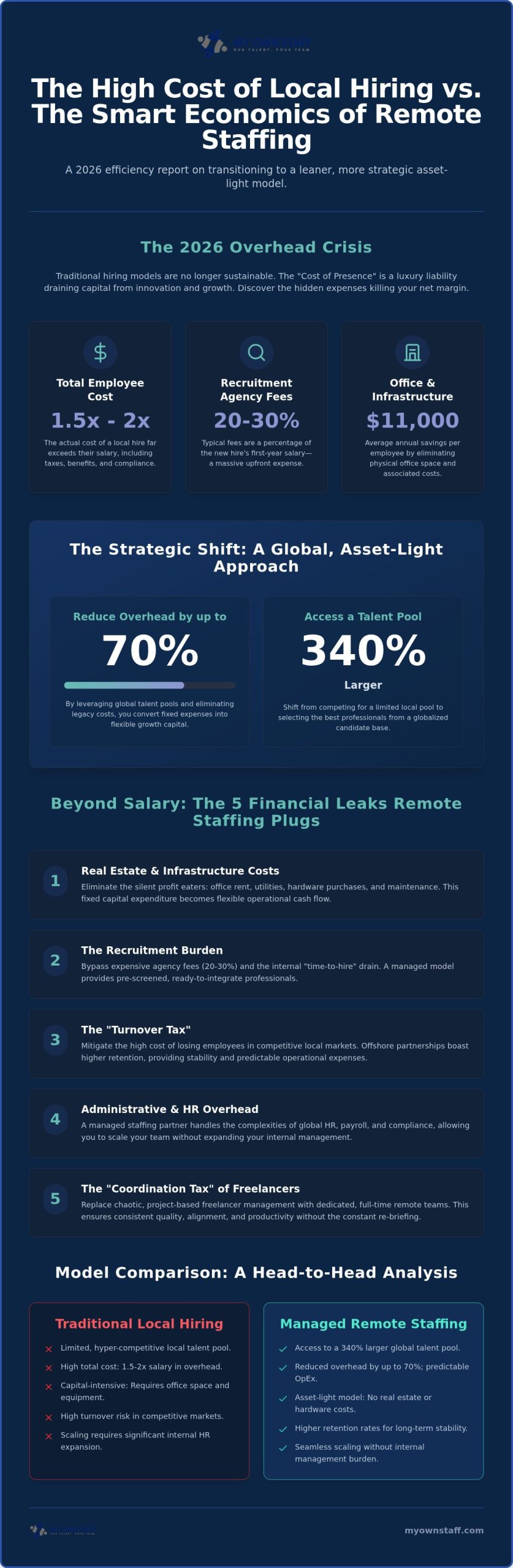
Traditional hiring models have hit a breaking point. In 2026, the “Cost of Presence” is no longer a standard business expense; it’s a luxury liability that drains capital away from innovation. Many organizations find themselves caught in a growth trap where adding local headcount actually decreases their net margin. This happens because the Total Cost of Ownership for a local employee extends far beyond their base salary. Between rising employer taxes, competitive benefit packages, and the administrative burden of local compliance, a single hire can cost 1.5 to 2 times their annual pay before they even complete a single task. Businesses that choose to reduce overhead with remote staff are finding they can bypass these legacy costs entirely while maintaining high operational standards.
The competitive landscape has shifted. Inflation and persistent talent shortages in major hubs have made local recruitment a high-risk gamble. When you hire locally, you’re competing for a limited pool of candidates who expect premium compensation to offset their own rising living costs. Organizations that pivot to a globalized talent pool gain access to a candidate base that is 340% larger than local alternatives. This shift allows for a more intentional, strategic approach to scaling that prioritizes skill and output over physical proximity.
The Hidden Costs of Local Recruitment
Recruitment is a silent profit killer. Agency fees typically range from 20% to 30% of a new hire’s first-year salary, creating a massive upfront expense. Even if you manage hiring internally, the “time-to-hire” drain pulls your leadership away from high-level goals for weeks at a time. Onboarding friction is equally expensive. In high-turnover markets, you risk spending months training a local professional only for them to leave for a marginal pay increase elsewhere. By contrast, a managed offshore model provides pre-screened professionals, such as Staff Accountants or Customer Success Teams, who are ready to integrate immediately. This removes the recruitment burden and shifts your staffing from an unpredictable capital expenditure to a predictable monthly operating expense.
Real Estate and Infrastructure: The Silent Profit Eaters
Maintaining a physical office is an outdated CapEx burden. When you calculate the true cost per square foot of an occupied desk, you must include utilities, hardware, janitorial services, and office maintenance. These costs add up to a significant portion of your monthly burn rate. Transitioning to an asset-light model is the dominant trend for 2026 because it converts these fixed costs into flexible growth capital. Research shows that companies can reduce costs for organizations by an average of $11,000 per employee annually by moving away from traditional office-centric models. This capital is better spent on lead generation or product development rather than rent for a half-empty suite in an expensive city center. Eliminating the need for expensive equipment and physical infrastructure allows your business to remain lean, agile, and ready to scale at a moment’s notice.
Beyond Salary: The 5 Hidden Financial Leaks Remote Staffing Plugs
Salary savings are the most visible benefit of a global team, but they’re only the tip of the iceberg. To truly optimize your bottom line, you must address the administrative “leaks” that drain your capital. When you reduce overhead with remote staff, you’re not just finding lower wages. You’re leveraging global wage arbitrage to secure high-tier talent without the local premium. This approach allows you to scale your IT and security infrastructure without the heavy burden of local hardware investments. Instead of purchasing laptops and servers for a local office, your managed partner ensures your team is equipped and secure, shifting these costs away from your balance sheet.
You can also eliminate the “Turnover Tax” that plagues local hiring. In competitive domestic markets, losing a single employee can cost a company tens of thousands of dollars in lost productivity and recruitment fees. Dedicated, long-term offshore partnerships offer significantly higher retention rates. Professionals in these roles often view these positions as long-term career milestones rather than stepping stones. This stability transforms your staffing from a series of unpredictable hiring spikes into a predictable monthly OpEx. It’s a strategic shift that allows you to identify cost savings that were previously hidden in your general ledger.
The Managed Service Advantage
Managing a remote team doesn’t have to mean managing more complexity. A single monthly fee replaces over ten administrative line items, including payroll taxes, workers’ compensation, and local benefits administration. Your staffing partner acts as a buffer, absorbing HR and payroll compliance risks so you don’t have to. This model is particularly effective when you need to access specialized talent like offshore accounting staff. You get the expertise of a seasoned professional without the mounting costs of local recruitment and benefits packages. It’s about removing friction and letting your leadership focus on high-level strategy.
Operational Flexibility and Rapid Scaling
Scaling should feel like an opportunity, not a risk. By using offshore staffing solutions, you can experiment with new roles or enter new markets 24/7 with minimal financial exposure. If a pilot project requires a new Lead Generation Specialist, you can deploy one without a long-term lease or a massive capital investment. Geographic arbitrage is the strategic practice of leveraging differences in labor costs across different regions to enhance a business’s competitive edge without compromising on professional standards. For brands experiencing rapid growth, implementing offshore staffing for ecommerce is a proven way to handle peak-season demand and back-office complexity without ballooning your fixed costs. If you’re ready to see how this model fits your specific needs, exploring a dedicated staffing partnership is the logical next step for your growth.
Solving the ‘Coordination Tax’: How Managed Staffing Beats Freelancer Chaos
Many business leaders hesitate to reduce overhead with remote staff because they fear the “Coordination Tax.” This hidden cost refers to the time spent aligning work, chasing updates, and correcting errors within a fragmented team. If you’ve ever managed a handful of project-based freelancers, you know the chaos of conflicting schedules and varying levels of commitment. The freelancer model often creates more administrative burden than it saves in wages. A dedicated professional, however, functions as a seamless extension of your internal team. They aren’t juggling five other clients; they’re focused exclusively on your goals, your workflows, and your success.
The difference between a shared resource and a dedicated professional is fundamental to your operational stability. While gig workers might provide a temporary fix, dedicated data entry staff offer a permanent solution to high-volume processing needs. They understand your data standards and internal logic, which eliminates the need for constant re-training. This reliability is backed by data. Harvard research on remote work productivity indicates that well-managed remote policies can increase employee output by 4.4% while simultaneously reducing turnover. By shifting from the gig economy to a managed staffing model, you replace coordination chaos with disciplined execution.
The Myth of Management Burden
The biggest objection to remote hiring is the belief that you’ll spend all day micro-managing. This is a myth. When you work with pre-screened talent, you’re hiring individuals who have already been vetted for their technical skills and communication abilities. A managed “Plug-and-Play” onboarding model ensures that these professionals are ready to contribute from day one. You can replace endless status meetings with clear KPIs and structured reporting. This shift allows you to manage by outcomes rather than by activity. It’s a cleaner, more efficient way to lead that frees up your time for strategic growth.
Building a Culture of Accountability
Accountability stems from dedication. A full-time remote professional feels a sense of ownership that an hourly freelancer simply cannot match. There is a psychological shift when you move from hiring “a virtual assistant” to integrating “My Own Staff” into your hierarchy. This sense of belonging drives higher performance and loyalty. For example, leveraging offshore IT support staff allows you to maintain 24/7 uptime without burning out your local team. These dedicated professionals take pride in keeping your systems running, providing a level of reliability that project-based contractors rarely achieve. You aren’t just buying hours; you’re building a resilient, accountable organization.
The 2026 Roadmap: Transitioning to an Asset-Light Staffing Model
Transitioning to an asset-light model requires more than a software subscription. It’s a disciplined shift in how you allocate resources. By following a structured roadmap, you can reduce overhead with remote staff while maintaining complete control over your operational quality. This journey begins with a clear-eyed assessment of your current infrastructure and identifying which departments are truly ready for a global transition. We recommend a “Pilot Program” approach. Start with high-impact, low-complexity roles that allow your team to build confidence in the model without risking core operations.
Setting up your digital HQ is the next critical phase. In 2026, this means implementing robust security protocols and collaboration tools that bridge the gap between time zones. Once the infrastructure is in place, you must measure the ROI over a 12-month horizon. Don’t just look at salary savings. Track the impact on your monthly burn rate, the reduction in HR tickets, and the speed of project completion. A successful transition should feel like a weight being lifted from your balance sheet, allowing you to reinvest that capital into market expansion.
Step 1: Identifying Your Overhead Leaks
Start by analyzing every task that doesn’t strictly require a physical presence in your local office. Many leaders find that back-office functions are the primary source of financial leakage. You should prioritize roles such as hiring data entry specialists remote to free up your local leadership for high-level strategy. This first step also involves calculating your current “Administrative Burden” per local employee. This figure should include everything from payroll tax and insurance to the time your HR team spends on local compliance. When these numbers are visible, the case for a remote transition becomes undeniable.
Step 2: Selecting the Right Staffing Partner
The success of your roadmap depends heavily on who you choose as your facilitator. Recruitment-only agencies often fail because they leave the ongoing administrative burden on your shoulders. In 2026, managed staffing is the superior choice because the partner absorbs the HR, payroll, and compliance risks. When vetting partners, ask specific questions about their candidate screening processes and how they provide ongoing support to the staff. You need to ensure cultural alignment and high language proficiency to maintain your brand’s standards. If you’re ready to identify which roles in your organization are remote-ready, you can schedule a workflow audit to begin your transition today.
Building a global team is a marathon, not a sprint. It requires a partner who is both strategically minded and operationally capable. By focusing on specialized roles first, you create a stable foundation for future growth. This methodical progression ensures that your team stays lean, your costs stay predictable, and your business remains competitive in an increasingly globalized market.
Strategic Efficiency: Why My Own Staff is the Logical Conclusion
Achieving true operational mastery requires more than just a change in policy. It requires a partner who can execute the complexities of global recruitment while you focus on high-level growth. My Own Staff acts as that bridge. We remove the friction typically associated with offshore hiring by handling the heavy lifting of screening, background checks, and administrative management. When you choose to reduce overhead with remote staff through our model, you aren’t just hiring an individual. You’re adopting a disciplined system designed for long-term stability and precision. We take the burden of complex tasks off your plate so you can focus on the strategic decisions that drive your business forward.
Our “Dedicated Only” philosophy is central to this success. We don’t offer shared resources because we know that split focus leads to split results. Your staff member is yours alone, integrated into your culture and trained on your specific workflows. This commitment to exclusivity is why our clients saw a reduction in overhead of 60% or more in 2025. By converting unpredictable hiring costs into a single, predictable monthly fee, you move from a cost-heavy legacy structure to a lean, asset-light organization that can outpace the competition. It’s a logical progression for any manager looking to optimize their organizational capacity without increasing their internal HR headcount.
A Partnership, Not Just a Placement
We provide a comprehensive service that goes beyond simple placement. While many agencies leave you to navigate the complexities of international HR, we handle everything from payroll compliance to ongoing performance support. This allows you to scale your team with specialized roles as your business evolves. You get the security of pre-screened, high-tier talent from the Philippines and other top global hubs without the administrative burden. It’s a supportive, partnership-oriented approach that ensures your remote transition is a stabilizing force for your company. We act as your dedicated guide, ensuring that every new hire is a seamless fit for your existing team.
Take the First Step Toward Operational Freedom
The path to a more efficient business starts with a single, strategic decision. You can request a custom staffing plan tailored to your specific overhead goals and department needs. Our onboarding process is designed to be stress-free, featuring a guarantee that ensures your new team member integrates seamlessly into your existing operations. We take on the burden of the complex tasks so you can reclaim your time and focus on what truly moves the needle for your growth. If you’re ready to see the numbers for yourself, book a discovery call to see how much overhead you can save today. It’s time to reduce overhead with remote staff and build the scalable, resilient organization your 2026 goals require.
Building a Resilient, Asset-Light Organization
The traditional hiring model is no longer the only path to growth. By choosing to reduce overhead with remote staff, you’re embracing a more agile, asset-light future that prioritizes output over physical presence. We’ve explored how a managed offshore model eliminates the administrative friction that often derails local expansion. You don’t have to carry the burden of recruitment or HR compliance alone. A strategic partnership allows you to focus on high-level goals while dedicated professionals handle your essential daily operations.
My Own Staff provides you with dedicated, full-time professionals who work exclusively for your brand. Our model includes complete HR and recruitment management as part of your predictable monthly fee. Whether you need specialists in IT, Finance, or Customer Success, we ensure a seamless integration into your team. You’re ready to move from a cost-heavy structure to one that prioritizes precision and scalability. Take the first step toward a leaner, more resilient organization today.
Scale your business and slash overhead with a dedicated remote professional today
Frequently Asked Questions
How much can I realistically save by hiring remote staff instead of local employees?
You can realistically slash your operational costs by up to 70% when you pivot away from traditional local hiring. Research from Global Workplace Analytics indicates that businesses save an average of $11,000 per employee annually by adopting remote models. These savings stem from the removal of expensive office leases, utilities, and the high tax burdens associated with on-site staff in major metropolitan hubs like New York or London.
Is there a hidden ‘coordination tax’ when managing offshore teams?
Coordination overhead is a common challenge for unmanaged teams, but it’s largely eliminated through a dedicated staffing model. Unlike freelancers who juggle multiple clients, a dedicated professional works exclusively for your business. This focus allows them to integrate into your daily workflows and communication channels; they function as a seamless extension of your internal team rather than a distant contractor with split priorities.
What are the most common roles that help reduce overhead for small businesses?
Small businesses often start with high-impact roles like Virtual Assistants, Lead Generation Specialists, and Data Entry Specialists to reduce overhead with remote staff. These positions handle the repetitive, administrative tasks that often drain the time of your local leadership. Transitioning these functions to a managed offshore partner allows your core team to focus on higher-level growth and strategic development without expanding your local HR footprint.
How do I ensure data security and compliance with remote workers?
Security is managed through rigorous candidate screening and the implementation of enterprise-grade digital tools. A professional staffing partner ensures that all remote professionals work within your established security protocols, using encrypted connections and multi-factor authentication. This structured approach provides the same level of data protection as an in-office setup while removing the burden of managing international labor compliance from your internal team.
Why is a managed staffing service better than hiring freelancers on platforms like Upwork?
Managed services provide long-term stability and dedicated focus that freelancer platforms cannot match. When you hire a freelancer, you’re often competing for their attention against several other clients. A managed service provides a full-time professional who is committed to your company’s long-term success. We handle the recruitment, HR, and payroll; you get a reliable team member without the administrative headache of the gig economy.
Can I hire specialized roles like accountants or IT technicians through remote staffing?
Yes, you can access highly specialized talent including Staff Accountants and IT Support Technicians. These professionals hold the same technical expertise as local hires but are available at a fraction of the cost. If you’re considering how to hire a remote IT support technician who can handle complex tickets without the premium local salary, a managed offshore model provides a proven path to securing that expertise. Using specialized remote staff is a proven strategy to reduce overhead with remote staff while maintaining the rigorous standards required for financial reporting and technical infrastructure management in a competitive market.
What happens if a remote staff member isn’t a good fit for my company?
If a staff member isn’t the right cultural or technical fit, a managed service provider facilitates a smooth replacement process. We take on the burden of finding a new candidate who better aligns with your specific needs. This minimizes disruption to your operations and ensures that your team remains productive without the high costs and stress typically associated with local employee turnover and recruitment agency fees.
How long does it take to get a remote professional up and running?
The onboarding process is designed for efficiency, typically taking a few weeks from the initial request to a fully integrated hire. This timeline includes the rigorous screening and selection process required to find a professional who meets your specific standards. Our “Plug-and-Play” model ensures that once the staff member begins, they have the necessary support and infrastructure to contribute to your business immediately.


