
What if the solution to your IT help desk turnover isn’t finding better local talent, but changing your definition of “local” entirely? You’ve likely felt the strain of skyrocketing Tier 1 and Tier 2 salaries. It’s frustrating to watch your best technicians leave while you struggle to provide the 24/7 coverage your global clients demand. Integrating dedicated offshore IT support staff offers a way to stabilize your operations and reclaim your growth trajectory.
We understand that maintaining a high-performing technical team often feels like an uphill battle. This guide will show you how to scale your capacity and reduce overhead by bringing specialized remote professionals into your core workflows. You’ll learn how to move beyond transactional ticket-clearing and build a strategic partnership that feels like a natural extension of your home office.
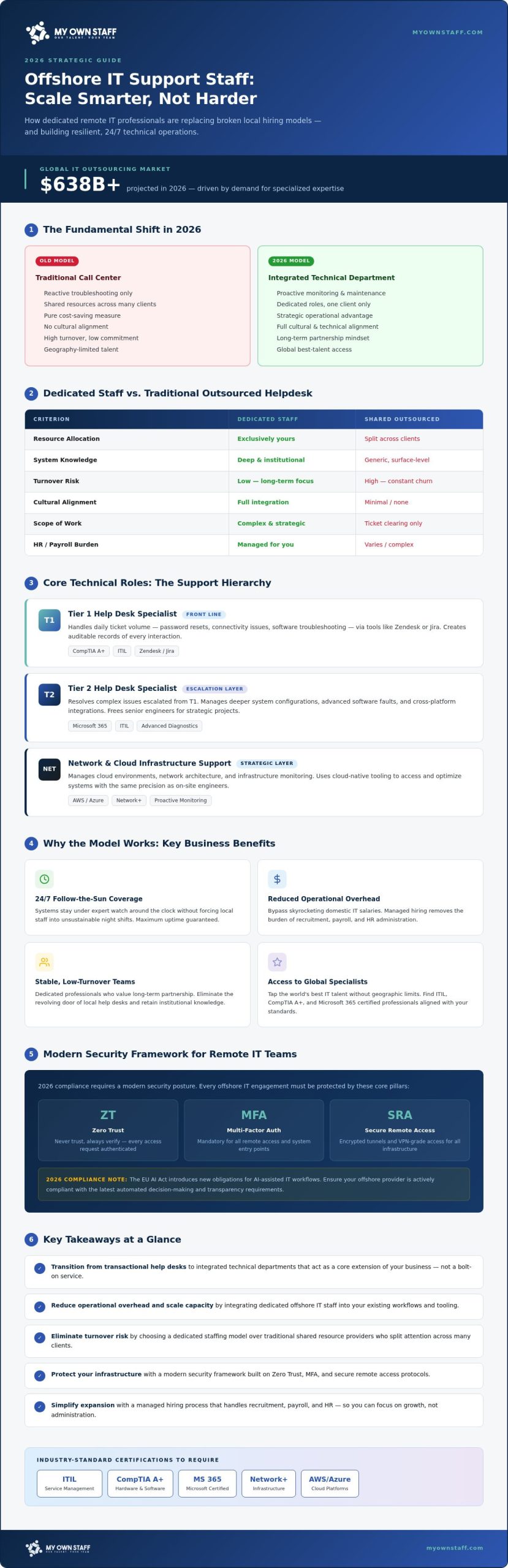
The global IT outsourcing market is projected to exceed $638 billion in 2026, driven by a shift toward specialized expertise. We’ll walk you through selecting the right professionals, ensuring seamless integration, and meeting the latest 2026 compliance standards like the EU AI Act. It’s time to replace operational friction with reliable, cost-effective technical mastery.
Key Takeaways
- Transition from transactional help desks to integrated technical departments that act as a core extension of your business.
- Reduce operational overhead and scale capacity by integrating dedicated offshore IT support staff into your existing workflows.
- Eliminate the risks of high turnover by choosing a dedicated staffing model over traditional shared resource providers.
- Protect your infrastructure with a modern security framework focused on Zero Trust, MFA, and secure remote access.
- Simplify your expansion by leveraging a managed hiring process that removes the burden of recruitment, payroll, and HR.
Defining Offshore IT Support Staff in the 2026 Landscape
The definition of global technical talent has changed. In 2026, businesses no longer view these teams as a desperate cost-saving measure, but as a sophisticated strategy for operational mastery. We are seeing a definitive shift from the traditional call center model toward integrated technical departments. Today, offshore IT support staff are dedicated professionals who manage complex infrastructure, ensure cybersecurity compliance, and drive digital transformation.
Understanding What is Outsourcing in this modern context requires looking past simple labor arbitrage. It’s about finding specialists who align with your company’s culture and technical standards. This isn’t about hiring a freelancer for a one-off project; it’s about building a stable foundation for your business growth. When you integrate these professionals correctly, they become indistinguishable from your local team in terms of quality and commitment.
Offshore IT support is the strategic integration of dedicated remote professionals who function as a core extension of your internal technical department rather than an isolated third-party service.
The Evolution of Technical Outsourcing
The days of reactive troubleshooting are over. Modern teams focus on proactive system monitoring and maintenance. This shift is largely due to the maturity of cloud computing. It allows remote technicians to access and manage systems with the same precision as someone sitting in your office. With the global IT outsourcing market projected to exceed $638 billion in 2026, the industry has matured into a high-stakes environment where quality is the primary currency. The “offshore” label now represents a strategic advantage. It signals that a company is agile enough to tap into the world’s best talent without being limited by geography. These teams don’t just clear tickets; they optimize environments.
Why Local Hiring is No Longer the Only Standard
Local talent pools are increasingly shallow. Many organizations face a severe shortage of Tier 1 and Tier 2 technical talent, making it difficult to maintain a stable help desk. Salaries for domestic IT roles have reached levels that strain even healthy budgets. Remote-first cultures have normalized the idea of global technical teams. This shift allows you to implement a “follow-the-sun” support model. Your systems remain under expert watch 24/7 without forcing local staff into unsustainable graveyard shifts. This approach ensures maximum uptime and keeps your core operations resilient. By looking globally, you bypass the high turnover rates common in local help desks and gain access to a dedicated workforce that values long-term partnership. You aren’t just filling a seat; you are securing a competitive edge.
Core Technical Roles: From Help Desk to Infrastructure
Building a high-performing technical team requires more than just filling seats. It demands a structured hierarchy where every professional understands their specific impact on your operations. When you integrate offshore IT support staff, the most successful strategy involves moving away from the “shared resource” model. Instead, you should focus on dedicated roles. This approach ensures your remote team members are fully immersed in your unique systems, internal culture, and long-term objectives. They don’t just clear tickets for multiple companies; they work exclusively for you.
We prioritize technicians who hold industry-standard certifications such as ITIL, CompTIA A+, and Microsoft 365. These credentials act as a foundational baseline for quality. They ensure your staff follows globally recognized frameworks for service management and technical execution. If you are looking to build this kind of specialized team, exploring offshore IT staffing services can help you identify the specific tiers your organization needs most to eliminate operational friction.
Tier 1 and Tier 2 Help Desk Specialists
These professionals handle the daily volume of technical requests that often bog down internal teams. Their responsibilities include troubleshooting software, managing password resets, and resolving connectivity issues. By utilizing ticketing systems like Zendesk or Jira, they maintain a clear, auditable record of every interaction. This frees up your local senior engineers to focus on high-level projects and strategic innovation. It’s an efficient way to optimize your existing resources while maintaining high user satisfaction.
Network and Cloud Infrastructure Support
Offshoring isn’t limited to basic troubleshooting. In 2026, dedicated remote staff manage complex AWS and Azure environments with high precision. They ensure network stability and perform enterprise-level monitoring at a fraction of the cost of a local hire. Research shows that offshore staff augmentation can cost 50-70% less than hiring for the same role in the US. This allows you to afford a level of infrastructure oversight that keeps your business resilient and scalable.
Cybersecurity and Compliance Monitoring
Security is a 24/7 requirement that local teams often struggle to sustain without burnout. Dedicated remote specialists provide continuous monitoring for threats and ensure your data remains compliant with GDPR or HIPAA regulations. Given that 78% of enterprise B2B buyers now require SOC 2 or ISO 27001 certification before signing a contract, having a dedicated team focused on these standards is a business necessity. If you’re ready to stabilize your technical operations, consider how My Own Staff can connect you with pre-screened IT professionals who fit your specific security needs.
Dedicated Staff vs. Traditional Outsourced Helpdesks
Choosing the right structural model for your technical team is just as important as the talent you hire. Many businesses fail to distinguish between a traditional Business Process Outsourcing (BPO) arrangement and a dedicated staffing model. This distinction often determines whether your offshore IT support staff become a high-value asset or a source of constant frustration. Traditional outsourcing typically relies on a shared resource model. In this setup, agents juggle tickets for multiple companies simultaneously, which prevents them from ever truly mastering your specific technical environment.
We advocate for a dedicated staffing model because it treats remote professionals as a permanent extension of your team. Unlike the high-turnover environment of a shared call center, dedicated staff work exclusively for you. They learn your workflows, understand your long-term goals, and build the institutional knowledge required to solve complex problems without constant hand-holding. This stability is the foundation of a reliable technical department. For a comprehensive look at how to structure this approach, our guide on building a dedicated offshore team walks through the strategic framework for scaling your workforce with pre-screened professionals in 2026.
The Problem with Shared Ticketing Queues
In a shared resource model, every ticket often feels like the first time an agent has seen your system. Because these agents rotate between different clients, they lack the context needed for proactive troubleshooting. This leads to inconsistent quality. You never know if the person picking up the phone has three months of experience with your stack or three hours. Misalignment is inevitable. Shared agents are incentivized to close tickets quickly to meet BPO quotas rather than ensuring the underlying issue is resolved for your business’s long-term health.
The Benefits of a Dedicated Remote Professional
A dedicated professional offers a level of accountability that shared queues cannot match. They become experts in your specific software stack, security protocols, and internal culture. This deep system knowledge allows them to move beyond basic troubleshooting into proactive system optimization. Integration is seamless. They join your internal Slack channels, participate in weekly standups, and share in your company’s successes. They aren’t “outsiders” performing a service; they are colleagues contributing to your growth.
Cost Optimization Without Quality Compromise
When evaluating the total cost of ownership (TCO), dedicated offshore staff provide a significant middle ground between expensive local hires and low-quality BPOs. While offshore staff augmentation typically costs 50% to 70% less than domestic hiring, the “hidden” costs of management and rework are much lower with a dedicated model. You get the stability of a full-time employee without the overhead of local payroll taxes and office space. Exploring modern offshore staffing solutions allows you to scale your technical capacity while maintaining the high standards your clients expect. This approach removes the friction of traditional outsourcing and replaces it with a disciplined, results-focused partnership.
Overcoming Challenges: Security, Culture, and Communication
Integrating offshore IT support staff into your core operations often raises concerns about data integrity and cultural alignment. These are valid points of friction. However, the technical landscape of 2026 provides robust frameworks to mitigate these risks. Security is no longer a barrier; it’s a protocol. By shifting from a trust-based model to a Zero Trust architecture, you ensure that every access request is verified, regardless of where the technician is located. This approach removes the ambiguity that often plagues remote management.
Building a successful global team requires a deliberate “cultural bridge.” This involves more than just language proficiency. It’s about aligning on technical standards, urgency levels, and documentation habits. When you treat your remote staff as true colleagues rather than distant contractors, these barriers dissolve. Reliability becomes the standard, not the exception. You’re not just hiring a worker; you’re expanding your company’s technical DNA across borders.
Ensuring Data Security and Compliance
With the average cost of a data breach climbing to $4.88 million, your security posture must be airtight. We recommend utilizing Virtual Desktop Infrastructure (VDI) to keep sensitive data within your own digital perimeter. This prevents local file storage on remote devices and gives you total control over the environment. Implementing the NIST Cybersecurity Framework (CSF) 2.0 helps you focus on governance and supply chain risk, which is essential for managing global teams in 2026. Rigorous background checks and standardized multi-factor authentication (MFA) protocols further solidify this defense. If you’re ready to secure your technical infrastructure with pre-screened professionals, you can hire dedicated IT support technicians through our managed recruitment process.
Mastering Remote Communication and Workflow
Friction in global teams usually stems from a lack of clarity, not a lack of talent. Standard Operating Procedures (SOPs) are your most valuable asset. They ensure that a technician in an offshore office follows the exact same troubleshooting steps as an engineer in your headquarters. Utilizing asynchronous tools like Loom for video walkthroughs or Notion for project tracking reduces the need for constant, draining meetings. The ‘Overlapping Hours’ strategy ensures that global teams share a four-hour window of synchronous time for high-stakes collaboration while maintaining independent productivity during local business hours. This balance allows for deep work without sacrificing the real-time communication needed for urgent technical issues. It turns a potential time zone hurdle into a strategic 24/7 advantage.
How to Build Your Offshore IT Team with My Own Staff
Building a global technical team shouldn’t feel like a second job. We act as your strategic partner, taking on the heavy lifting of recruitment so you can focus on higher-level goals. By integrating dedicated offshore IT support staff through our managed model, you bypass the friction of traditional hiring and gain a reliable, stable workforce. We’ve refined our process to ensure that every hire is a precision fit for your organization’s technical needs and internal culture.
Our commitment to your success doesn’t end with a signed contract. We remain an active participant in your growth, ensuring that your remote team members are supported and your administrative burdens are eliminated. This structured approach provides the peace of mind you need to scale your operations with confidence.
Step 1: Role Discovery and Custom Sourcing
We start by identifying your specific technical requirements. This includes the exact software stack you use and the certifications your team needs, such as Microsoft 365 or CompTIA. Custom sourcing beats generic job boards every time. Instead of sifting through hundreds of unqualified resumes, you access a pre-screened talent pool tailored to your industry. This precision ensures we find professionals who aren’t just capable, but are the right fit for your unique operations. We focus on finding individuals who view this as a long-term career, which is the most effective way to solve the turnover issues common in local help desks.
Step 2: Rigorous Technical Screening
Our vetting process is exhaustive. We test for technical proficiency, problem-solving abilities, and communication skills. Clear communication is the backbone of any remote team. It’s the difference between a resolved ticket and a frustrated client. once we’ve narrowed the field to the top candidates, you step in for the final interview. This allows you to evaluate the culture fit and ensure the individual aligns with your company’s values. For a deeper look at what this process entails, our guide on how to hire a remote IT support technician walks through each stage of the screening and selection process in detail. This expert-led approach significantly reduces hiring risk and guarantees a high-caliber addition to your team.
Step 3: Seamless Onboarding and Ongoing Support
Integration is the final piece of the puzzle. We help you onboard your new staff member into your existing ticketing systems, Slack channels, and internal workflows. My Own Staff handles all the administrative overhead, including payroll, benefits, and local compliance. You don’t have to worry about the complexities of international HR or tax laws. We remain your long-term partner, providing ongoing support and helping you scale your team as your business grows. If you’re ready to reclaim your time and stabilize your technical capacity, book a discovery call today to see how we can build your dedicated technical team.
Empower Your Business with Global Technical Mastery
The shift toward a global technical workforce is no longer just about cost; it’s about agility and operational excellence. By choosing a dedicated model, you ensure that your team possesses the deep institutional knowledge required to protect your infrastructure and support your users effectively. Integrating offshore IT support staff provides a scalable solution to the talent shortages and skyrocketing costs that often hinder local expansion. Scaling your IT capacity doesn’t have to be a source of stress.
We specialize in connecting you with pre-screened, dedicated professionals who offer full-time exclusivity to your business. Our comprehensive approach includes all administrative and HR management, allowing you to bypass the complexities of international staffing. You deserve a technical team that is reliable, secure, and fully aligned with your long-term success.
Scale your technical team today with dedicated offshore IT support from My Own Staff. We look forward to helping you build a more resilient and efficient future.
Frequently Asked Questions
What is the difference between offshore IT support and traditional outsourcing?
The primary difference lies in the level of dedication and integration. Traditional outsourcing usually relies on a shared resource model where agents handle tickets for multiple companies at once. In contrast, dedicated offshore IT support staff work exclusively for your business. This allows them to master your specific systems, culture, and long-term goals, functioning as a true extension of your internal team rather than a distant service provider.
How do you ensure the security of my data with offshore staff?
Security is maintained through a combination of rigorous protocols and modern technology. We recommend a Zero Trust architecture where every access request is verified regardless of location. Utilizing Virtual Desktop Infrastructure (VDI) ensures that sensitive data never leaves your secure perimeter. Additionally, standardized multi-factor authentication and compliance with frameworks like NIST CSF 2.0 provide a robust defense against unauthorized access or data breaches.
What technical certifications should I look for in offshore IT support staff?
You should prioritize candidates who hold globally recognized credentials that align with your infrastructure. For foundational support, CompTIA A+ and ITIL certifications ensure a baseline of technical skill and service management excellence. If your operations are cloud-based, look for Microsoft 365, AWS Certified Cloud Practitioner, or Azure Fundamentals. These certifications guarantee that your staff follows industry-standard frameworks for troubleshooting and system optimization.
Can offshore IT staff work in my specific time zone?
Yes, dedicated remote professionals are hired to align with your specific business hours. Whether you need a “follow-the-sun” model for 24/7 coverage or an “overlapping hours” strategy for synchronous collaboration, the staff works the schedule you define. This ensures that your technical support is available exactly when your users or global clients need it most, without forcing your local team into unsustainable shifts.
What happens if a dedicated offshore staff member leaves?
The managed staffing model includes full recruitment and replacement support to minimize operational downtime. If a team member leaves, the agency handles the search, screening, and initial onboarding of a new professional who fits your technical requirements. This removes the stress of the hiring process from your shoulders. Because we maintain a pre-screened talent pool, the transition is efficient and follows your established documentation and SOPs.
How much can I expect to save by hiring offshore IT support staff?
Research indicates that offshore staff augmentation can cost 50% to 70% less than hiring for the same technical role in the US or UK. These savings extend beyond just the base salary; you also eliminate the overhead associated with local payroll taxes, office space, and equipment. This cost optimization allows you to reinvest your budget into high-level strategic projects while maintaining a stable, full-time technical team.
Do offshore IT support technicians have experience with modern tools like ServiceNow or Jira?
Yes, proficiency in industry-standard ticketing and project management tools is a core part of our technical screening process. Most professionals are highly experienced with platforms like ServiceNow, Jira, and Zendesk. During the discovery phase, we verify that your offshore IT support staff have the specific software experience needed to integrate into your existing workflows without a steep learning curve.
How do I manage a remote IT team effectively across different cultures?
Effective management relies on clear documentation and consistent communication habits. Developing robust Standard Operating Procedures (SOPs) ensures that technical tasks are performed uniformly across all locations. Utilizing asynchronous tools like Loom or Notion alongside synchronous platforms like Slack helps bridge the gap between time zones. Treating your remote staff as colleagues by including them in standups and team meetings builds the trust necessary for long-term technical collaboration.


