
Why are you still battling a local talent shortage and skyrocketing payroll when the world’s best professionals are ready to join your team right now? You likely recognize that scaling your operations requires more than just extra hands; it requires dedicated experts who align with your vision. Yet, the friction of international compliance and the fear of communication breakdowns often make the decision to hire offshore employees feel like a risky gamble. It’s frustrating to face recruitment fatigue while your overhead continues to climb.
We understand that you need reliability and results, not more administrative stress. This guide provides a comprehensive checklist to help you identify, vet, and integrate high-performing offshore professionals who drive growth without the typical headaches. We’ll walk you through navigating the latest 2026 labor regulations, selecting the right talent hubs, and establishing seamless workflows. By the end, you’ll have a clear roadmap to reduce costs and build a dedicated team that scales with your ambition.
Key Takeaways
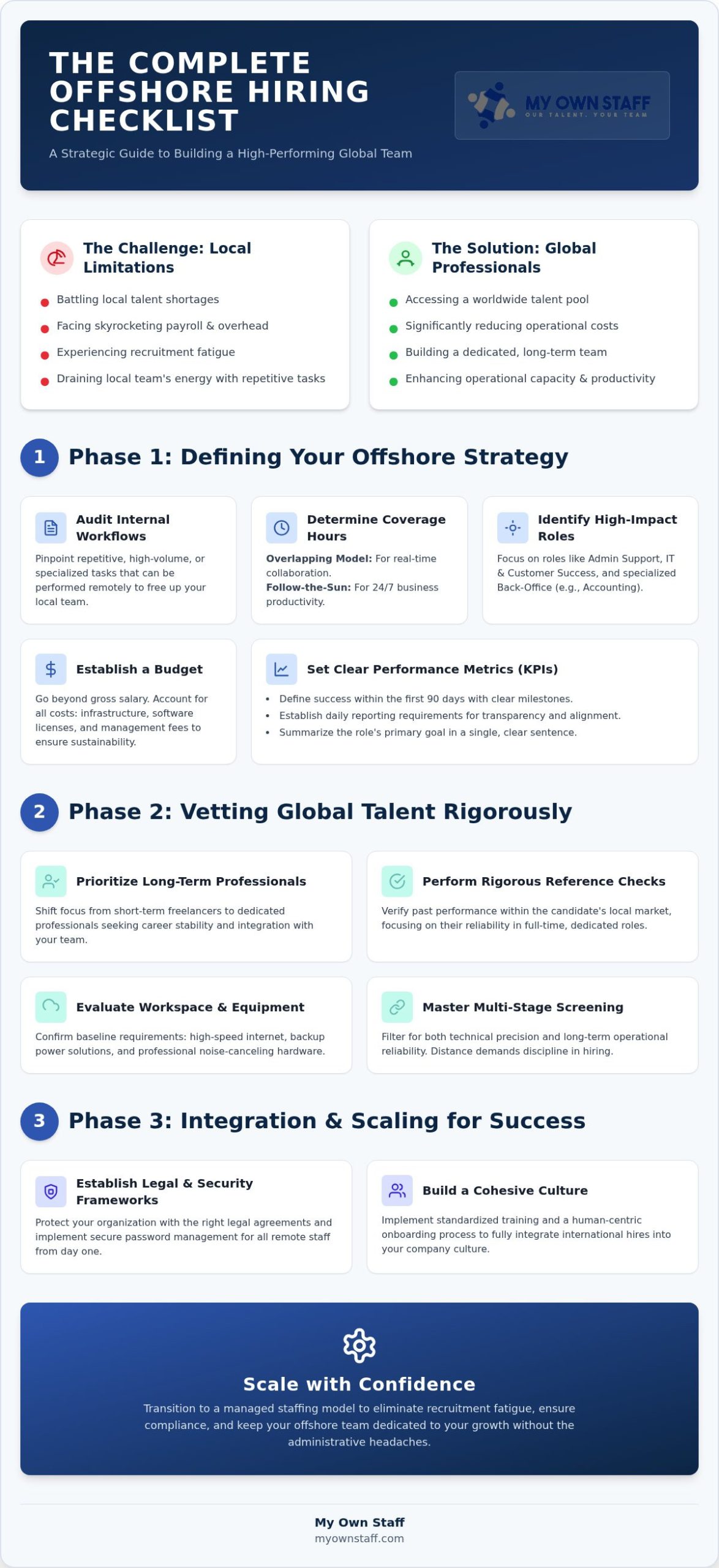
- Audit your internal workflows to pinpoint high-volume, remote-capable tasks that are ready for a dedicated professional.
- Master a multi-stage screening strategy to hire offshore employees who offer technical precision and long-term reliability.
- Protect your organization by establishing the right legal framework and implementing secure password management for all remote staff.
- Build a cohesive culture through standardized training bases and a human-centric onboarding process for international hires.
- Transition to a managed staffing model to eliminate recruitment fatigue and ensure your offshore team remains dedicated to your growth.
Defining Your Offshore Strategy: A Pre-Hiring Checklist
Before you begin reviewing resumes, you must define the scope of your expansion. An offshore employee is a dedicated professional based internationally who functions as a full-time extension of your local team. This is a fundamental shift from project-based freelancing; it is about building a permanent, loyal workforce. Developing a clear understanding of offshoring allows you to move beyond simple cost-cutting and focus on long-term strategic growth. When you decide to hire offshore employees, you aren’t just filling a seat. You’re enhancing your operational capacity with a partner who is invested in your success.
Success begins with a rigorous workflow audit. Analyze your current processes to identify repetitive, high-volume, or specialized tasks that don’t require a physical presence in your office. Ask yourself which functions are currently draining your local team’s energy. These are your prime candidates for offshoring. Once you identify the tasks, determine your required coverage hours. You might prefer an overlapping model for real-time collaboration during your standard business day. Alternatively, a follow-the-sun model allows your business to remain productive 24/7, with offshore staff picking up where your local team leaves off.
Establishing a transparent budget is the final pillar of your strategy. A realistic budget must account for more than just the gross salary. Consider the costs of infrastructure, software licenses, and management fees. By accounting for these variables upfront, you ensure a sustainable operation that avoids hidden financial surprises. This structured approach moves you away from the “recruitment headache” and toward a model of operational mastery. For a deeper look at how to structure your global expansion from the ground up, the complete guide to offshore staffing solutions for 2026 provides a detailed framework for reducing overhead while stabilizing your operations.
Identifying High-Impact Offshore Roles
Focus on roles that remove friction from your core team and allow you to scale without adding administrative burden. Consider these high-impact options:
- Administrative and Support: Use a virtual assistant Philippines based to handle lead generation, complex scheduling, and data entry with precision.
- Customer Success and IT: Build a dedicated team of IT support technicians and customer success specialists to manage technical helpdesk inquiries and user retention.
- Specialized Back-Office: Scale your finance department with offshore accounting staff who manage complex ledger tasks and financial reporting.
- Sourcing and Procurement: For businesses with physical products, Buying Office Asia provides professional on-the-ground support to manage manufacturing and supply chain operations across the region.
Setting Clear Performance Metrics (KPIs)
Clarity is the foundation of reliability in a remote environment. You must define what success looks like for the role within the first 90 days. This roadmap should include specific milestones for training completion and independent task execution. Establish daily reporting requirements from the start to maintain transparency. This practice ensures that distance never translates into a lack of oversight or alignment. Finally, create a single sentence defining your primary goal for the offshore hire. If you can’t summarize the role’s purpose simply, your professional won’t be able to execute it effectively. When you hire offshore employees with this level of clarity, you set the stage for a high-performing, long-term partnership.
Vetting Global Talent: The Rigorous Selection Checklist
Identifying the right talent requires more than a casual glance at a digital resume. Many businesses fail because they treat the process like hiring a freelancer for a one-off task. To successfully hire offshore employees, you must shift your focus toward finding dedicated professionals who seek long-term career stability. This begins with a multi-stage screening process designed to filter for both technical excellence and operational reliability. Distance demands discipline. You aren’t just looking for a set of skills; you’re looking for a reliable partner who integrates into your daily workflow.
Verify professional history through rigorous reference checks within the candidate’s local market. This step is non-negotiable. You need to understand how they performed in a full-time, dedicated environment rather than relying on a curated portfolio. Additionally, evaluate their physical workspace and equipment standards. In 2026, high-speed data is a baseline requirement, but you must also confirm they have backup power solutions and noise-canceling hardware. Technical failures are productivity killers. Proactive vetting prevents these issues before they impact your bottom line. If you want to skip the stress of manual vetting, you can partner with a managed staffing provider to access a pre-screened talent pool immediately.
Skill Assessment and Technical Testing
Administer time-bound tests using the specific software and tools your business relies on daily. Don’t rely on self-reported expertise. Verify technical certifications for specialized roles, particularly for IT support technicians or staff accountants. Effective Strategies for managing overseas staff start with ensuring candidates possess high-level English proficiency. Test both written and verbal communication along with reading comprehension. This ensures that instructions aren’t lost in translation and that your new hire can contribute to complex discussions from day one.
Assessing Soft Skills and Cultural Alignment
Interview specifically for proactive communication. You need a team member who has the confidence to flag potential issues before they become expensive problems. Assess their familiarity with Western business etiquette and their ability to adapt to your specific company culture. This adaptability ensures a seamless transition and reduces friction during the onboarding phase. Cultural alignment is the primary predictor of offshore retention because it transforms a distant worker into a connected member of your core team. When you hire offshore employees who share your values, you build a loyal workforce that grows alongside your company.
Compliance and Security: The Operational Safety Checklist
Operational mastery requires more than just finding the right talent; it demands a secure and legally sound infrastructure. When you hire offshore employees, you are extending your company’s digital and legal perimeter across international borders. This expansion should never be an afterthought. Establishing a robust international employment framework is your first priority. You must decide whether to hire directly, use an Employer of Record (EOR), or partner with a managed staffing agency. Direct hiring often brings heavy administrative burdens and complex tax obligations. Using a managed staffing model allows you to offload these liabilities while maintaining full control over your team’s output.
Security starts with access control. Implement a centralized password management system like LastPass or 1Password to ensure your sensitive credentials never leave your control. These tools allow you to grant and revoke access instantly, providing peace of mind as your team scales. Beyond digital access, you must protect your intellectual property (IP). Draft robust NDAs and IP protection agreements that are specifically enforceable in the staff’s local jurisdiction. An agreement that works in your home country might hold little weight elsewhere. Ensuring local enforceability is a critical step in mitigating long-term risk.
Data Security and IP Protection Protocols
Protecting your data requires a layered defense. Ensure all work occurs within company-monitored cloud environments rather than on local hard drives. This setup ensures that your data remains within your ecosystem at all times. Follow these essential protocols:
- Secure Connectivity: Require the use of encrypted VPNs for accessing any sensitive company servers.
- Account Integrity: Mandate multi-factor authentication (MFA) on all internal accounts to prevent unauthorized access.
- Asset Control: Use remote management software to monitor hardware health and security compliance.
Navigating International Employment Laws
Local labor laws vary significantly by region, affecting everything from mandatory 13th-month pay to specific holiday entitlements and termination protocols. You must understand the tax implications of your chosen model. For example, hiring independent contractors often carries different legal risks than employing managed staff through a partner. Adopting best practices for managing offshore teams includes verifying that your payment methods comply with both local and international banking regulations. For businesses that want to streamline their fiscal processes, Financial Foothold provides outsourced accounting operations and payroll administration. To eliminate the risk of non-compliance, many leaders choose to hire offshore employees through a managed service that handles these complex legalities on their behalf. This strategic move allows you to focus on growth while your partner manages the operational safety net.
Onboarding for Success: The Team Integration Checklist
The moment you hire offshore employees, your focus must shift from selection to integration. A successful start isn’t accidental. It requires a disciplined, step-by-step approach to ensure your new professional feels like a valued extension of your team rather than a distant contractor. Start by standardizing your training documentation into a searchable internal knowledge base. This resource allows your new hire to find answers independently, reducing the burden on your local management. When information is accessible, productivity begins on day one.
Schedule a ‘Day One’ welcome call with your local team to humanize the new hire and set a collaborative tone from the very first hour. To smooth the transition, assign a ‘buddy’ or mentor for the first two weeks. This person serves as a go-to for informal questions about company culture or specific task nuances. Establish accountability early by setting up recurring weekly 1-on-1 meetings. These sessions are vital for discussing progress, addressing roadblocks, and maintaining a high level of operational transparency. This structured interaction builds a sense of order and reliability.
Communication and Workflow Setup
Removing the friction of distance requires the right digital infrastructure. Establish clear channels for both real-time and asynchronous work to keep projects moving forward. Consider this setup:
- Real-Time Collaboration: Use Slack or Microsoft Teams for instant communication and quick huddles.
- Task Management: Implement project management tools like Asana, ClickUp, or Monday.com to track deliverables with precision.
- Availability: Define ‘Core Hours’ where the offshore employee must be available for live meetings and collaborative sessions.
Building Long-Term Engagement
True integration goes beyond software and tasks. Include your offshore staff in company-wide meetings and celebrations to foster a sense of belonging. Provide a clear, documented path for professional development and salary increases. The ‘Engagement Gap’ represents the psychological disconnect that occurs when remote staff feel isolated from company goals; closing it requires consistent, two-way feedback loops that value their contribution. When employees see a future with your company, they remain dedicated to your growth. If you want to eliminate the administrative burden of setting up these systems yourself, you can leverage a managed staffing model to ensure your team is integrated and supported from the start.
Scaling with Confidence: The My Own Staff Managed Solution
Executing a global recruitment strategy shouldn’t feel like a second full-time job. While the previous chapters provide a roadmap for success, the manual execution of these steps often leads to significant recruitment fatigue. When you decide to hire offshore employees, you shouldn’t have to become an expert in international tax law or a full-time headhunter. The managed staffing model offers a strategic shortcut. This approach transitions you from the “recruitment headache” to a state of operational mastery, where your only focus is on your core business goals. We take on the burden of identifying, vetting, and managing your talent so you can focus on high-level growth.
Our managed solution eliminates the common risks associated with remote hiring, such as “ghosting” or inconsistent performance. By providing pre-screened, dedicated professionals who value their roles, we ensure that your team remains stable and productive. We handle the complexities of payroll, local benefits, and ongoing HR support within a flexible, predictable monthly fee structure. This model allows you to scale your team up or down with ease, providing a level of agility that traditional hiring models simply cannot match. It is about removing friction and enhancing your organizational capacity through a partnership built on transparency and results.
Why Dedicated Staff Beat Freelancers
The difference between a freelancer and a dedicated staff member is the difference between a vendor and a partner. To hire offshore employees who truly drive value, you need commitment. Dedicated staff offer several distinct advantages:
- Loyalty and Knowledge: They develop a deep understanding of your specific business processes and company culture over time.
- Reliable Availability: Your staff is available during your critical business hours, ensuring seamless collaboration without the delays of project-based work.
- Consistent Quality: Dedicated professionals focus exclusively on your tasks, avoiding the “juggling” act typical of freelancers who manage multiple clients simultaneously.
Streamlining Your Growth with Managed Staffing
Our managed staffing model is designed for speed and retention. By leveraging our pre-screened talent pool, businesses can reduce their typical time-to-hire by up to 70%. This efficiency allows you to respond to market demands instantly rather than waiting months to fill a critical role. Beyond the initial hire, our ongoing support model ensures high retention rates by providing staff with a professional environment and clear career paths. We act as your operational safety net, ensuring your international expansion is both secure and scalable. Ready to skip the recruitment stress? Book a discovery call with My Own Staff today and start building your dedicated team with confidence.
Secure Your Future with Strategic Global Talent
Building a global team is no longer just an option; it’s a strategic necessity for businesses that want to remain competitive in 2026. By following a structured approach to identify high-impact roles and implementing a multi-stage vetting process, you eliminate the risks that often derail international expansion. You’ve seen how establishing a secure employment framework and prioritizing cultural integration transforms distant workers into loyal, high-performing team members.
When you’re ready to hire offshore employees without the complexity of managing international payroll and HR, a managed solution is the logical choice. We provide access to a pre-screened, high-quality talent pool of dedicated professionals who focus exclusively on your growth. Take the next step toward operational mastery and let us handle the full-service recruitment and HR management for you. Scale your business with dedicated offshore staff from My Own Staff today. Your path to efficient, stress-free growth starts here.
Frequently Asked Questions
What is the difference between an offshore employee and a freelancer?
An offshore employee is a dedicated, full-time extension of your local team, while a freelancer typically works on a project-by-project basis for multiple clients. This distinction is vital for long-term stability. Dedicated staff integrate into your company culture and workflows, offering consistent availability and deep institutional knowledge that freelancers simply cannot provide during high-growth phases.
How do I handle time zone differences when I hire offshore employees?
You can manage time zone differences by choosing either an overlapping model for real-time collaboration or a follow-the-sun model for 24/7 productivity. Many businesses require a four-hour overlap during their core operating hours to facilitate meetings and instant communication. This structure ensures that distance never hinders your operational rhythm or project timelines when you hire offshore employees.
Is it legal for a US company to hire offshore staff directly?
Yes, US companies can legally hire offshore staff, but they must navigate complex international labor laws and specific tax regulations. Directly hiring requires you to comply with the legal standards of the employee’s home country, including benefits and termination protocols. Many leaders choose a managed staffing model to offload this legal liability and ensure total compliance without the administrative burden.
What are the most popular countries for offshore hiring in 2026?
The Philippines and India remain the primary hubs, with the Philippines offering a daily minimum wage of PHP 755 in the National Capital Region as of July 2026. Poland and Brazil are also growing rapidly; Poland’s national minimum wage reached PLN 4,806 per month in early 2026. These regions provide a diverse pool of highly skilled professionals across IT, accounting, and customer success roles.
How do I ensure my company data is safe with offshore workers?
Data safety is maintained through a combination of secure digital infrastructure and strict operational protocols. You should mandate the use of encrypted VPNs and multi-factor authentication for all internal accounts. Ensure all work occurs in company-monitored cloud environments rather than on local devices to maintain total control over your intellectual property and sensitive client information at all times.
What roles are best suited for offshore staffing?
Roles that are remote-capable and process-driven are ideal, such as virtual assistants, IT support technicians, and staff accountants. Customer success teams and data entry specialists also thrive in this model. These functions allow your local team to focus on high-level strategy while dedicated international professionals manage essential back-office operations and technical support with precision.
How much can I save by hiring offshore compared to local staff?
Hiring offshore allows you to reduce labor overhead significantly compared to the costs of local recruitment and retention. You typically avoid the high expenses of local payroll taxes, office infrastructure, and expensive benefit packages. This managed staffing model provides a predictable monthly fee, allowing you to reinvest those substantial savings into scaling your core operations and driving growth. Early-stage companies looking to maximize these savings can find a detailed breakdown in this 2026 offshore staffing guide for startups, which outlines how high-growth companies reduce burn rates without sacrificing talent quality.
What happens if my offshore employee isn’t a good fit?
If an employee isn’t a good fit, your next steps depend on your specific employment framework. In a direct hire model, you must follow the termination protocols of the staff member’s local jurisdiction to avoid legal risks. Partnering with a managed staffing provider simplifies this process, as they handle the transition and identify a replacement from their pre-screened pool without interrupting your daily workflow.


